
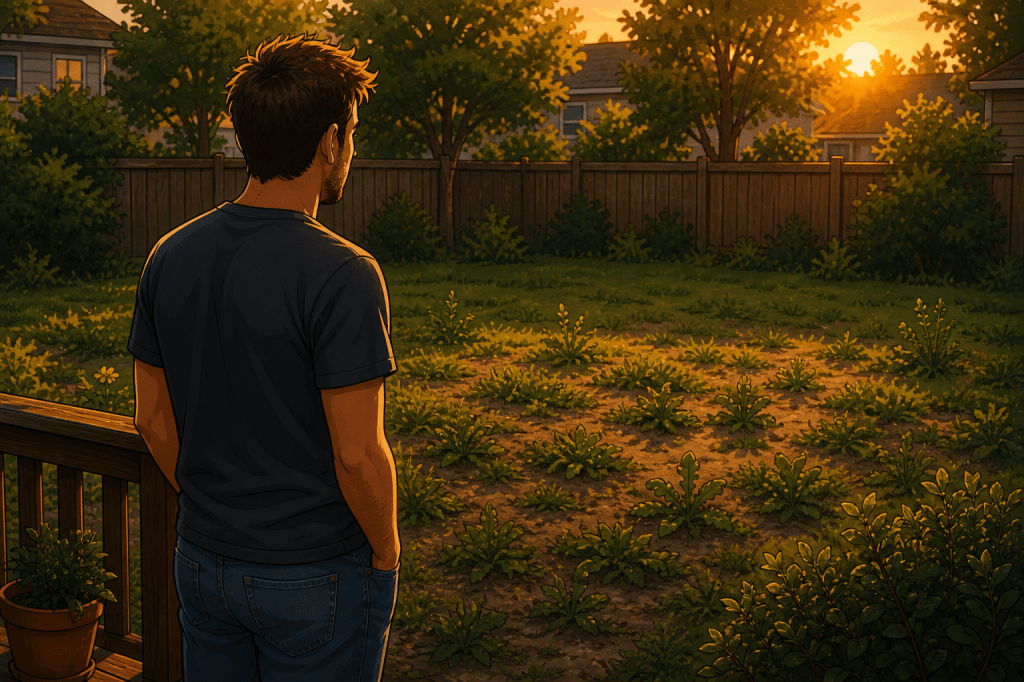
The other day I stood in my yard looking at more weeds than grass, holding my phone like it was going to solve the problem for me.
It wasn’t.
It was just showing me another lawn-care subscription.
A plan.
A schedule.
A box at the door.
A promise that if I paid enough, maybe this could become one less thing I had to figure out myself.
And honestly, that was the part that almost got me.
Not the fertilizer.
Not the branding.
Not even the convenience.
The relief.
Because what I wanted was not really lawn care.
I wanted one less problem that belonged to me.
I think that’s what makes those kinds of solutions so appealing.
They don’t just offer help.
They offer distance.
They make the problem feel cleaner. Smaller. More manageable.
Like maybe if someone else puts it in a box, gives it a schedule, and sends instructions, the weight of it changes.
And sometimes maybe it does.
But not always.
Once I slowed down and looked closer, my yard didn’t need the polished solution.
At least not yet.
It needed timing.
It needed prep work.
It needed soil contact.
It needed waiting.
It needed me to not throw more stuff on top of the problem just because I wanted to feel like I was doing something.
Which, naturally, is very rude of the yard.
A few days later, I caught myself doing the same thing with pest control.
Different problem.
Same temptation.
Pay someone. Subscribe to something. Let a cleaner-looking solution make the problem feel less complicated.
But when I looked closer, that problem was simpler than the subscription made it seem.
It didn’t need a quarterly plan with nice branding.
It needed a basic solution used carefully, and only when necessary.
Nothing fancy.
Just the right thing, done the right way.
That was the part I couldn’t stop thinking about.
Sometimes we make things more expensive because we want them to feel easier.
And sometimes we make things look easier because we don’t understand how much work they actually take.
Those sound like opposites, but I think they come from the same place.
We want problems to be simple.
I know I do.
A messy yard looks like:
“Just seed it.”
A bug problem looks like:
“Just spray something.”
A broken process looks like:
“Just fix it.”
From the outside, that can sound reasonable.
Simple, even.
But inside the problem, “just” is rarely simple.
Inside the problem, you start to see the layers.
If I seed too soon, it may not work.
If I add the wrong product, I may make it worse.
If I rush the fix, I may create another problem.
Suddenly the issue is not just about doing something.
It is about doing the right thing at the right time, in the right order, without pretending consequences do not exist.
And I think that is where a lot of frustration grows.
One person sees the weeds.
Another person sees the timing, the soil, the last thing that was applied, the next step that has to wait, and the thing that could go wrong if they rush it.
One person sees the visible mess.
Another person is trying to understand the system underneath it.
Those are not always opposing views.
But they can feel that way when nobody slows down long enough to notice.
The outside view says:
“Why hasn’t this been fixed yet?”
The inside view says:
“I’m trying to fix it without breaking something else.”
That difference matters.
Because what looks like delay may actually be caution.
What looks like overcomplication may actually be experience.
What looks like doing nothing may actually be someone slowing down enough to do it right.
That’s the part I keep coming back to.
Sometimes what looks like resistance is actually responsibility.
Not perfection.
Not heroics.
Just someone trying to slow down long enough to make the next right move.
Checking.
Adjusting.
Asking more questions.
Trying not to turn one problem into three.
I understand the outside view.
I have been there too.
When you are not carrying the details, simplicity feels obvious.
It is easy to look at someone else’s messy yard, messy process, or messy life and think you know what needs to happen.
Sometimes you might even be right.
But being right about the problem does not always mean you understand the work.
That is what I want to remember.
Before I assume something is simple.
Before I get frustrated that something is taking longer than I think it should.
Before I decide someone else should have already handled it.
There may be more underneath than I can see.
I still want the yard fixed.
I still want simple answers.
I still want fewer things on my plate, because apparently adulthood is just being slowly defeated by grass, bugs, bills, and software.
But I’m learning that the right solution is not always the easiest-looking one.
Sometimes the right solution is slower.
Less impressive.
More careful.
More honest.
And maybe most of the time…
we are only seeing the weeds.
Not the work beneath them.
 DadHD Brain
Leave a comment